In earlier posts, I
took on both Brendan Rodgers and Louis van Gaal; the former for failing to appreciate the psychological aspect of
the game, the latter for getting it quite wrong. Belgian football’s clásico announced itself as a
good test for the importance of the mental element of the game, if any. Steven
Defour was to return to Standard’s Sclessin, the stadium he had left for Porto, back in 2011, with
Anderlecht, Standard's nemesis. The Rouches had made it very clear in the build-up to the game that their former captain would be in for a warm
welcome back. The Belgian international had informed the media he had prepared himself for
the worst and kept it to himself how he would celebrate scoring a
possible goal for his new employer at his former ground.
 |
| Source: voetbalbelgie.be |
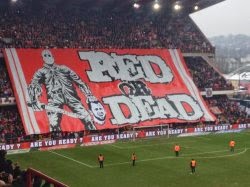
Defour was welcomed
into the stadium with an enormous banner showing
his chopped-off head dangling from his killer’s hand. As in most countries, also
according to Belgian law death threats tend to be considered a serious offense,
but football folklore as well as on-the-pitch proceedings at times appear to be
exempt from the general rules - and more so in the South of the country. How did Defour react? Did he remain stoic under
the “folkloristic” death threat? Was he to score and, if so, would he celebrate?
Top behavioural economist Uri Gneezy, together with Alex Imas, in a recent paper titled Materazzi Effect
and the Strategic Use of Anger in Competitive Interactions, studied the effects
of angering a player in different types of games. They conducted two separate
experiments: one concerned a game of strength; the other a mind-game. In both
cases, the scientists established what the effect would be of a player angering his
opponent. They found that in the case of the game of strength, the angered
opponent was able to put his anger to a productive use, transforming it into more
strength. In the mind-game, in contrast, the provoked player saw this anger
interfere with his judicious decision-making, “losing his cool”, ultimately to the detriment of
his performance. Angering one's opponent in a game of strength, thus, would
be counterproductive, whereas in a mind-game it pays.
In the spirit of
Gneezy and Imas’s study, the Belgian clásico provided an exceptional
testing ground to see whether football is mainly a trial of strength,
or whether the mental aspect may actually dominate - obviously assuming both sides are at a high and comparable skill level. If Defour was to shine, the enmity
against him would seem to have boosted him, in line with the depiction of football as a trial of strength. Should he give in to the acrimony,
that would be anecdotal evidence rather for the football-as-mind-game
conception.
So what happened?
During the first half, Defour got booked for kicking the ball high and ostentatiously into the stands, after the referee had blown
his whistle for a hand-ball. In the second half, when a Standard player was down and in some need of attention, Defour put the
ball out of play by aiming it fiercely straight into the home crowd - moreover, after the referee had blown his whistle. The referee had no other choice but to book Defour again for an “unforced error” very similar to the one he had committed in
the first half. It took quite some minutes before Defour was actually ready to
leave the pitch.
 |
| Source: voetbal24.be |
From a single-case
study perspective, Defour’s self-inflicted sending off would appear to point to the
provocation having had quite the intended “losing one’s cool” effect rather than none
or even a boosting effect. Recalling Gneezy and Imas’s study, this would be
anecdotal evidence towards football primarily
being a mental battle: “Our results suggest that anger affected performance differently
depending on the game…: anger had a positive effect on performance when the
game involved strength and a negative effect when the game was more mental.” (emphasis added)
Finally, I would like
to focus on the (potential) role of the coach. Anderlecht’s Besnik
Hasi recently won the award for best manager in the league, after having made Anderlecht
league champion last season, out of an almost lost position. Furthermore, his players,
particularly the younger ones, seem to be most fond of him and to confide in his
ability to make them better. His weakness, however, seems to be his lack of
control on their behaviours, aggravated by an unwillingness or inability to
reprimand them. The former is demonstrated by Anderlecht players
repeatedly having been quarreling with each other on the pitch over who was to take
a penalty or free-kick and eventually the goal-keeping captain having to cross
the field to bring the internal dispute to a conclusion. The latter was evidenced recently when Anderlecht's enfant terrible Mitrovic first shoved in the back and then nastily elbowed an opponent.
When confronted with the unambiguous images after the game, Hasi, puzzlingly,
declared Mitrovic “clearly had not touched his opponent”.
Next to the
above-mentioned main effect, scientists Gneezy and Imas also found in their experiments that
“[t]hese behavioral effects were mitigated, however, when individuals had an
opportunity to cool off before competing” – with a cool-down period of a mere ten minutes sufficing in their experiments. The half-time break could then have been a chance for Defour to cool down and avoid getting a second booking. Valuable time also for a coach to bring him to his senses – and, if unable to to so, to protect the player against himself by substituting him. Defour appeared not in control of his emotions also going into the second
half, however, got himself sent off at 0-0 and saw his employer suffer a painful 2-0
defeat.
As the legendary Rinus
Michels said, “voetbal is oorlog”. Football is war. Those generals who treat
that war as primarily being about physical strength should not be surprised to continue to see their
best men raging ahead toward their own deaths.


