t

t
Showing posts with label pressure. Show all posts

Tuesday, 2 May 2017

ABBA Instead of ABAB? What’s the Fuss?

At this year’s annual International Football Association Board (IFAB) meeting, the body in charge of the Laws of the Game decided to start experimenting with an alternative sequence for taking penalties during a shootout. Instead of having both teams take turns (i.e. ABABABABAB), as they have always done in football, a sequence akin to the one of serving in a tiebreak in tennis (i.e. ABBAABBAAB) will be tried out. Could this have any impact on who is to win a shootout, really? The answer is an unequivocal ‘yes’. And science helps us understand why.

In 2010, two Basque economists, Ignacio Palacios-Huerta and José Apesteguía, showed that in actual penalty shootouts in football, the team shooting first ends up winning in approx. 60% of cases; the team going second only in about 40%. This is quite a difference with both teams winning half, which is what would have been both expected and desirable. These findings imply that the toss deciding which team could go first imparts an enormous competitive advantage.

The mechanism behind this advantage is the so-called “lagging-behind effect”. The lagging-behind effect represents the simple fact that it is more difficult to convert a given penalty if one's team is behind in the score at the point of taking the kick than when not behind, due to the enhanced pressure such a “near-to-losing” situation creates as one “has to score” to keep one's team in the game.

Source: diariosdefutbol.com

It is easy to see why such a lagging-behind effect, under the current sequence, results in an advantage for the team going first, simply by considering both teams' first kick. What is the probability that team A is lagging behind at the time of their first kick? Naturally, this is zero as all’s square at that point. Now it is up to team B to take their first kick. Their chance of lagging-behind at this point? With penalties being converted at a rate of approx. 75%, there’s about a 75% chance team A will just have scored and thus a 75% chance that team B are lagging behind when taking their own first kick. So a 0% vs. a 75% chance of lagging behind on the very same kick. Under the current ABAB-sequence, in which every time team A get to act and team B to react, this pattern will be preserved and the resulting lagging-behind effect knocked on till the end.

In case of applying an ABBA-sequence, as in a tennis tiebreak, instead, the advantage of having the opportunity to force the lagging-behind effect upon the opponent rather shifts from one team to the other: it, again, starts with team A, but then moves to team B as they get to go twice; then to team A that get to go twice, etc. The whole idea being that the influence of whoever may win the coin toss and thus be able to go first will have only minimal impact on who will win.

In addition to the abovementioned empirical research uncovering the lagging-behind effect, together with Profs. Brian McCann and Govert Vroom, we were able to prove, through theoretical (mathematical) research, soon to appear in the Journal of Sports Economics, that, in case of a lagging-behind effect, the ABBA-sequence substantially reduces the advantage of winning the toss relative to the current sequence. However, we also prove that there is yet another “natural” sequence, known as “Prouhet-Thue-Morse”, which reduces this advantage even more than the ABBA-sequence does. Perhaps something to add to next year’s IFAB meeting’s agenda J

Sunday, 25 January 2015

A Game of Football: Trial of Strength or Mind-Game?

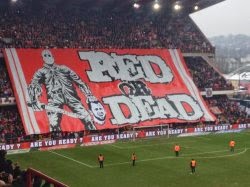
In earlier posts, I took on both Brendan Rodgers and Louis van Gaal; the former for failing to appreciate the psychological aspect of the game, the latter for getting it quite wrong. Belgian football’s clásico announced itself as a good test for the importance of the mental element of the game, if any. Steven Defour was to return to Standard’s Sclessin, the stadium he had left for Porto, back in 2011, with Anderlecht, Standard's nemesis. The Rouches had made it very clear in the build-up to the game that their former captain would be in for a warm welcome back. The Belgian international had informed the media he had prepared himself for the worst and kept it to himself how he would celebrate scoring a possible goal for his new employer at his former ground.

Source: voetbalbelgie.be

Defour was welcomed into the stadium with an enormous banner showing his chopped-off head dangling from his killer’s hand. As in most countries, also according to Belgian law death threats tend to be considered a serious offense, but football folklore as well as on-the-pitch proceedings at times appear to be exempt from the general rules - and more so in the South of the country. How did Defour react? Did he remain stoic under the “folkloristic” death threat? Was he to score and, if so, would he celebrate?

Top behavioural economist Uri Gneezy, together with Alex Imas, in a recent paper titled Materazzi Effect and the Strategic Use of Anger in Competitive Interactions, studied the effects of angering a player in different types of games. They conducted two separate experiments: one concerned a game of strength; the other a mind-game. In both cases, the scientists established what the effect would be of a player angering his opponent. They found that in the case of the game of strength, the angered opponent was able to put his anger to a productive use, transforming it into more strength. In the mind-game, in contrast, the provoked player saw this anger interfere with his judicious decision-making, “losing his cool”, ultimately to the detriment of his performance. Angering one's opponent in a game of strength, thus, would be counterproductive, whereas in a mind-game it pays.

In the spirit of Gneezy and Imas’s study, the Belgian clásico provided an exceptional testing ground to see whether football is mainly a trial of strength, or whether the mental aspect may actually dominate - obviously assuming both sides are at a high and comparable skill level. If Defour was to shine, the enmity against him would seem to have boosted him, in line with the depiction of football as a trial of strength. Should he give in to the acrimony, that would be anecdotal evidence rather for the football-as-mind-game conception.

So what happened? During the first half, Defour got booked for kicking the ball high and ostentatiously into the stands, after the referee had blown his whistle for a hand-ball. In the second half, when a Standard player was down and in some need of attention, Defour put the ball out of play by aiming it fiercely straight into the home crowd - moreover, after the referee had blown his whistle. The referee had no other choice but to book Defour again for an “unforced error” very similar to the one he had committed in the first half. It took quite some minutes before Defour was actually ready to leave the pitch.

Source: voetbal24.be

From a single-case study perspective, Defour’s self-inflicted sending off would appear to point to the provocation having had quite the intended “losing one’s cool” effect rather than none or even a boosting effect. Recalling Gneezy and Imas’s study, this would be anecdotal evidence towards football primarily being a mental battle: “Our results suggest that anger affected performance differently depending on the game…: anger had a positive effect on performance when the game involved strength and a negative effect when the game was more mental.” (emphasis added)

Finally, I would like to focus on the (potential) role of the coach. Anderlecht’s Besnik Hasi recently won the award for best manager in the league, after having made Anderlecht league champion last season, out of an almost lost position. Furthermore, his players, particularly the younger ones, seem to be most fond of him and to confide in his ability to make them better. His weakness, however, seems to be his lack of control on their behaviours, aggravated by an unwillingness or inability to reprimand them. The former is demonstrated by Anderlecht players repeatedly having been quarreling with each other on the pitch over who was to take a penalty or free-kick and eventually the goal-keeping captain having to cross the field to bring the internal dispute to a conclusion. The latter was evidenced recently when Anderlecht's enfant terrible Mitrovic first shoved in the back and then nastily elbowed an opponent. When confronted with the unambiguous images after the game, Hasi, puzzlingly, declared Mitrovic “clearly had not touched his opponent”.

Next to the above-mentioned main effect, scientists Gneezy and Imas also found in their experiments that “[t]hese behavioral effects were mitigated, however, when individuals had an opportunity to cool off before competing” – with a cool-down period of a mere ten minutes sufficing in their experiments. The half-time break could then have been a chance for Defour to cool down and avoid getting a second booking. Valuable time also for a coach to bring him to his senses – and, if unable to to so, to protect the player against himself by substituting him. Defour appeared not in control of his emotions also going into the second half, however, got himself sent off at 0-0 and saw his employer suffer a painful 2-0 defeat.

As the legendary Rinus Michels said, “voetbal is oorlog”. Football is war. Those generals who treat that war as primarily being about physical strength should not be surprised to continue to see their best men raging ahead toward their own deaths.

Tuesday, 9 September 2014

No Substitute for a Winning Strategy, Louis!?

As the number of countries qualifying for the next EURO Cup is to increase by no less than 50(!)%, it is, sadly, undue to pay any heed to the qualifiers: whoever wants to participate – except for Gibraltar – can and will. So I prefer to come back to one of the most striking moments at this summer’s World Cup, i.e. the rabbit staying inside van Gaal’s hat during Nederland's semi-final against Argentina.

As most will remember, during Oranje’s quarterfinal against Costa Rica, right before the shootout, van Gaal had come up with the unseen move of substituting the penalty-inapt Cillessen by the gigantic Krul. And the ploy paid off big time. Krul turned out to be not just a talisman but truly exceptional at saving penalties, diving into the right corner at every occasion and saving two. Nothing short of an epiphany. Costa Rica’s Navas was elected man of the match, but would not be the goalie to be remembered from that game. Van Gaal had once more proved himself a tactical mastermind, unbound by convention.

In the next round match, the semi-final against Argentina, it again came to penalties. But this time, there was no substitution left once penalties had become inevitable. Oranje's secret weapon was to remain shackled on the bench – and soon to exit the tournament. Cillessen, who reportedly had never saved a penalty in his professional career, did not manage to stop one that night either, bringing his personal penalty performance at 0/17.

Source: welt.de

As van Gaal explained after the game, “If I had had the opportunity to substitute Jasper [Cillessen] I would have done that but I had already used three substitutes so I couldn’t do that. I thought it was necessary to get van Persie out because he was on his last legs… My feeling was that Huntelaar would make the goal.” So van Gaal presents it as if there wasn't any space for him to maneuver. Accepting the premise that van Persie was “on his last legs”, substituting him apparently meant that it was ruled out for Krul to save the day.

Was that necessarily so, though? When van Persie was brought off, there were still 25 minutes on the clock. However, once in extra time, a shootout becomes more than a remote probability. In fact, since the adoption of penalty shootouts by FIFA in 1976, out of the 43 World Cup games that had gone into extra time, 25 (so 58%) went into shootouts.

I will argue that with Cillessen Nederland hardly stood any chance of winning a shootout at the '14 WC anymore. Several years of conducting research into penalty shootouts, together with Profs. Govert Vroom (IESE) and Brian McCann (Vanderbilt University), have helped me to appreciate the role played by psychological pressure in these events. In terms of skill, there is typically not much that separates the sides at such a level and small differences in the pressure experienced and pressure-handling abilities are likely to amplify. 

If your goalkeeper tends not to be very good at stopping penalties, this is usually not a big deal, as the pressure is on the kicker. However, given van Gaal’s move in the previous game, it was now all too clear to everybody – not in the least Cillessen himself, his teammates and the opposition – that this particular goalkeeper was so lame – incapable even – of stopping a spot kick, one would not just contemplate the bold move, but actually go as far as having him substituted, if possible. Talking about taking off the edge for the Argentine kickers. And reminding the Dutch ones of the likely outcome in case of a miss.

The crux of the problem was that it had effectively become impossible for van Gaal to return to the status quo of before his substitution of Cillessen in the quarterfinal, when Cillessen had been “exposed”. Starting a shootout with the Ajax goalie thereafter would be nothing short of suicide. The hapless Dutch nr. 1 further accentuated his helplessness during the semi-final shootout by attempting to mimick Krul’s intimidation tactics – an unconvincing performance to say the least. Van Gaal could have realised that his substituting Cillessen in the previous game was a double-edged sword and that fielding him in a shootout later on in the tournament now simply was no longer a viable option.

Now, let’s revisit van Gaal’s comments. Again taking for granted that van Persie was actually “on his last legs”, did this necessarily imply doom for the Dutch team? Far from it. At least two alternative options remained open, in fact:

Option 1. Check whether van Persie, (one of) Oranje’s most proficient penalty kicker(s), would be up for kicking a penalty, despite his tired legs. In case he's up to the task, take him off and continue the game with ten men. Playing with one man less indeed implies you are just hoping to reach the shootout, but it is far from certain you wouldn’t manage to (e.g. out of the 12 World Cup games, since 1976, where a team that had been or had come to be a man down during extra time, only twice did this team lose during extra time. One of those instances, however, happened to be Nederland losing the 2010 World Cup final...). Under this option, replace Cillessen by Krul at the very end; van Persie takes a penalty.

Option 2. Van Persie is not up for taking a penalty. You substitute him by Krul, who enters as a field player. The task of Krul during extra time would be to stay out of trouble and be there at corners (he’s 193 cm). During Oranje’s training camp in Brazil, Krul had actually already acted as a field player. Psychologically, it would also be a constant reminder for the Argentines of what they had coming as the clock was ticking away. Come the final whistle, Krul would just pick up his gloves – no need for Cillessen to be substituted. Downside is that neither van Persie nor Huntelaar would be eligible to kick a penalty.

Hard to judge from a distance whether van Persie was up for a penalty. But it would always be either one of these alternative options for me – too young to die. Of course, we have the advantage of hindsight. What would you have done had you been in Louis's shoes?