t

t

Wednesday, 11 March 2015

Third-Party Ownership for Dummies – So What Is the Problem, Really?


UEFA recently started creating a big fuss about Third-Party Ownership (TPO), depicting it as a major potential threat to professional football. I will explain briefly what TPO is about and summarize three main reasons why it can indeed be considered hazardous to the integrity of the game.

What is TPO?

Typically, when a player is transferred from one team (“team A”) to another (“team B”), the acquiring team (B) pays a transfer fee to the selling team (A), entitling the acquiring team (B) to the “ownership rights” of the player. Concretely, this means that if team B was to sell the player again later on, team B, in turn, would be netting a transfer fee for the player – ideally, one larger than what was previously paid to team A, so as to make a net profit.

In case of TPO, it is no longer a transaction involving only - or even mainly - the clubs; rather, an athlete’s “ownership rights” are in the hands of a third-party owner, which has invested in the athlete under the assumption a substantial amount of future transfer fees can be generated out of him/her. So in case a player, whose “ownership rights” are in the hands of a third-party owner (“C”), is being transferred to a team B, the transfer fee team B is paying will be cashed in by C, with team A being left empty-handed (assuming, for simplicity, the player is 100% third-party owned).

The threats of TPO to the integrity of the game

At first sight, it may seem as if TPO merely implies a player can cash in earlier on his/her future potential, handing on the risk to a third party. At closer inspection, however, the game of football risks to suffer greatly from TPO, mainly for the following reasons:
                                                       
1.       Third-party owner C will receive a return upon its investment if and only if the player is being transferred. Each time the player moves teams, C will be passing by the cash register, implying C's goal will be to have the player move teams as often as possible.
                                                        
2.       An even more serious problem concerns “conflict of interests” as TPO threatens to fundamentally alter the relationship between an athlete and his/her agent, substantially increasing the power of agents. Let me illustrate this by means of an example. In a system without TPO, the power, even of a “superagent” such as Jorge Mendes, largely resides in his/her network and is thus informal. Ultimately, the agent is hired by the athlete, to take care of those aspects the athlete would like to entrust the agent with. José Mourinho, for instance, employs Jorge Mendes to take care of Mourinho’s business for him. 

Source: 101greatgoals.com

A potential – but not yet material – conflict of interest arises when Mendes is also representing some players belonging to Mourinho’s team – in this case Chelsea – but not others. After all, the agent has an interest only in those athletes in his/her “portfolio”. Mendes, thus, may encourage Mourinho to pay particular attention to those players when it comes to giving them playing time.

The reason why this potential conflict of interest does not need to materialize is because the agent is in a subordinate position to the athlete.The athlete can easily hire and fire his/her agent. So Mourinho's interests will be Mendes's; Mendes's interests won't necessarily be Mourinho's.

This dynamic between athlete and agent stands to change fundamentally as a result of TPO. In the case of Mourinho, his “ownership rights” are in the hands of a third-party investor, in which superagent Mendes happens to have a major stake. So no longer is Mendes merely “hired” by Mourinho, Mendes now actually “owns” Mourinho, let it be indirectly. Such a structure may make any request by the agent potentially much more persuasive: Mendes's interests will now also be Mourinho's. In economic terms, TPO thus risks reversing the "principal-agent" relationship: whereas without TPO, Mendes would be Mourinho's agent, with TPO, Mourinho stands to become a pawn in the portfolio owned by Mendes.
                                                                      
Mourinho-Mendes relationship in a world without (left) and with (right) TPO

The fact that we currently are still living in a world with TPO may not be alien to why, e.g. the Belgian football press prophesied an even brighter future for Chelsea's Charly Musonda Jr. as he recently dumped his former agent for…Jorge Mendes.

Source: voetbalspot.be

3.       Another real threat posed by TPO again relates to clubs and coaches losing out control to agents and parties who are in it for the money. Third-party owners may offer their players to teams, which normally would not be able to afford the transfer fee, in return for certain conditions, e.g. that they will always be fielded. In the short term, this essentially implies the manager having to cede team decision-making to business interests. In the longer term, it also exposes the club to the danger of being substantially weakened as it is to receive no compensation, i.e. transfer fee, when the “star player” moves on and, thus, without means to find a suitable replacement.

While not directly related to TPO, the case of (former) Chelsea loanee Thorgan Hazard to Belgian Zulte-Waregem serves to illustrate both mentioned aspects. First, Hazard's entourage negotiated that their poulain would have to be awarded the captain's band, confronting coach Dury with a foregone conclusion and upsetting the dressing room. Second, while, under impulse of Hazard, Zulte-Waregem peaked to become vice-champion, after the golden boot had left - without receiving any compensation - the club quickly found itself fighting relegation (admittedly, other key players had left the club as well). Whereas fans may prefer such peaks and troughs, Zulte-Waregem's stability and balance, arguably, did not seem to have fared well by the Hazard saga.

Rather than claiming that, say, Mourinho, will necessarily give in to any demands by his agent, with or without TPO, I have sought to illustrate how TPO stands to change relative power and the incentive structure involved. While UEFA may have its own rationale for strongly opposing TPO, my intention has been to summarize the main reasons why, from a long-term perspective of the good of the game, it's recommendable putting up a fight.

Saturday, 21 February 2015

"Mineirazo": When the Tactical Meet the Coaching Mistakes

Many of us are yet to fully comprehend Brazil’s 1-7 semi-final elimination against Germany at last summer’s World Cup they hosted. Alternative explanations are abound, e.g. Zico's on FIFA's website. As I am yet to come across a “satisfactory” one, I will share mine.

As the case for many historic disasters, in entirely different spheres, I argue that the Mineirazo can be put down to a combination of tactical failings and inadequate organisational culture. As football psychology coach Dan Abrahams puts it in his book Soccer Brain, “[w]hilst the odd tactical mistake can happen it is primarily mindset and coaching culture that…spark[] great games, champagne moments… It is mindset and coaching that can, conversely, generate poor performances, nightmare matches…”

The coaching mistake

As I was on the plane destination Mineirão – an omen perhaps? – for Belgium’s first group game, I was startled when watching the on-board pre-World Cup reportages featuring interviews with the Brazilian players. The message of the twenty-something-year olds was univocal and boiled down to this: ‘Mark our words, people of Brazil, we are going to make up for the maracanazo, set history right and bring the World Cup home. We are the chosen generation of players to make this happen.’ This youthful optimism reflected just how eager they were to bring joy to their people. The one to protect the overenthusiastic youngsters from inviting unreasonable pressure onto themselves, however, and to canalize this positivism into a winning mindset, tactical discipline and focus on a common goal was the coach. As for the coach, as Abrahams puts it, “Optimism, yes – ignorance, no!”

It seemed, though, that Scolari took little decisive action to prevent his youthful team’s optimism turn into ignorance. This was manifested in two different ways. First, for a coach to cultivate a winning mindset amongst his players should not be confounded with not having contingency plans for when things don't go that smoothly. Rather than believing they are too good to fall behind, players should have the conviction that even if one or two goals down, they are going to bring this game home and how to make that happen.

In Abrahams’s words: “The champion…doesn’t allow herself to become engulfed in emotion as she competes.” If this is what marks the champion, then Brazil clearly was not one: after conceding a first and second goal against Germany, it was clear from the players’ collective (non-)reaction they had never given it any serious thought what to do in case this situation would arise. With the third goal came the realization that the World Cup for them was over and that they were not going to deliver upon their promise. No longer were they professional football players who would see this game out with minimal damage, they all just wished they were somewhere else and it seemed most of them already were.

Source: lanacion.cl

Imperatively, there had already been a clear warning the Seleção were not in control of their emotions as players broke into tears before taking a penalty kick in the shootout concluding their second-round game against Chile. Following such a clear mental breakdown of players during a game in which Brazil flirted more than once with elimination, one would expect a psychologically seasoned leader such a Scolari to mentally prepare his troops for a scenario different from raising the trophy Bellini-style on July 13th – even if only to raise the chances that the latter actually would happen. And, although the eventual win against Chile may have put sand into their eyes, after Neymar’s injury, reality should have kicked in that World Cup victory would not come as a walk in the park.

Second, it is important to realize that in a short tournament, as opposed to a league, luck and elements such as a refereeing decision, an injury or suspension may have a huge impact. Most favourites appreciate that it therefore has little sense to claim they are going to win the competition, but rather that they stand a good chance of getting far in the tournament. Not the Brazilians. They were sure to win, which reflects neither an accurate understanding of the opposition, nor of the structure of the competition. One can point to the absence of Neymar and Thiago Silva in their semi-final game, but it is exactly such factors – which are far from uncommon – that, over a run of a maximum of seven games, can prove decisive and, again, something for which one ought to have a contingency plan.

The (two main) tactical errors

In all honesty, before the start, I expected Brazil’s poacher Fred would come out as one of the tournament's top scorers. After five games, however, his main “contribution” had been to steal a penalty in the very first game. His nickname “o Cone” (the cone) may perhaps show too little appreciation for his main role of permanently attracting defender attention onto himself, thus creating space for Neymar. Now, with Neymar out due to injury, however, there was no-one for Fred to attract attention away from. Rather, he would have to create the danger himself, something he had shown to be utterly incapable of during the previous games. Still, although Fred’s role had become obsolete following Neymar’s injury, Felipão surprised by yet again having a spot for “o Cone” in his starting line-up.

In addition, fielding only two centre-backs in combination with very attacking wing-backs implied little defensive security, especially against an opponent of the likes of the Nationalmannschaft. The defensive formation was particularly risky considering it was untested and ad hoc, in response to Thiago Silva’s absence. Naturally, the wing-backs could have realized, at least at some point, they had better provide more defensive support to their two central-defensive colleagues who were all too often left drowning.

Is it really fair to blame the coaches then? After all, we all know how these Brazilians are: they see a ball and all they can think about is performing a samba-like jogo bonito. Was such tactical indiscipline really characteristic, though, of Oscar, Willian, David Luiz and Ramires under Mourinho; Dante under Guardiola; Hulk under Villas-Boas; Fernandinho under Pellegrini; Marcelo under Ancelotti; Paulinho under Sherwood; Thiago Silva and Maxwell under Blanc? These are world class players who, when playing for their clubs, hardly resemble the headless Brazilian chicken European romanticists may fantasize about. Oscar, for instance, is considered to have become one of the trequartistas who works hardest for his team you may find in the game – under Mourinho.

Source: dailymail.co.uk

The combination of tactical and coaching errors leading to the Mineirazo is all the more surprising as the CBF had intentionally sought to combine tactical savvy (Parreira) with motivational knowhow (Scolari). Brazil’s most cardinal sin then perhaps was to categorically cling on to domestic coaches. With the game evolving rapidly, it would indeed appear that opening up to other ideas is a necessary requirement to stay competitive in the global arena. A piece of anecdotal evidence may be that an English coach is yet to win a Premier League title. Another, that Sir Alex Ferguson is believed to have made his career sustainable in part by having embraced evolutions in mainland European football by hiring Portuguese Carlos Queiroz as his assistant. Indeed, it is not so much about the coaches' nationality per se, but, in Abrahams’ terms, about their mindset and coaching culture.

Sunday, 25 January 2015

A Game of Football: Trial of Strength or Mind-Game?

In earlier posts, I took on both Brendan Rodgers and Louis van Gaal; the former for failing to appreciate the psychological aspect of the game, the latter for getting it quite wrong. Belgian football’s clásico announced itself as a good test for the importance of the mental element of the game, if any. Steven Defour was to return to Standard’s Sclessin, the stadium he had left for Porto, back in 2011, with Anderlecht, Standard's nemesis. The Rouches had made it very clear in the build-up to the game that their former captain would be in for a warm welcome back. The Belgian international had informed the media he had prepared himself for the worst and kept it to himself how he would celebrate scoring a possible goal for his new employer at his former ground.

Source: voetbalbelgie.be

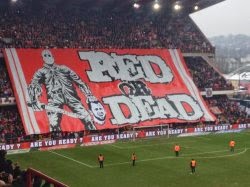
Defour was welcomed into the stadium with an enormous banner showing his chopped-off head dangling from his killer’s hand. As in most countries, also according to Belgian law death threats tend to be considered a serious offense, but football folklore as well as on-the-pitch proceedings at times appear to be exempt from the general rules - and more so in the South of the country. How did Defour react? Did he remain stoic under the “folkloristic” death threat? Was he to score and, if so, would he celebrate?

Top behavioural economist Uri Gneezy, together with Alex Imas, in a recent paper titled Materazzi Effect and the Strategic Use of Anger in Competitive Interactions, studied the effects of angering a player in different types of games. They conducted two separate experiments: one concerned a game of strength; the other a mind-game. In both cases, the scientists established what the effect would be of a player angering his opponent. They found that in the case of the game of strength, the angered opponent was able to put his anger to a productive use, transforming it into more strength. In the mind-game, in contrast, the provoked player saw this anger interfere with his judicious decision-making, “losing his cool”, ultimately to the detriment of his performance. Angering one's opponent in a game of strength, thus, would be counterproductive, whereas in a mind-game it pays.

In the spirit of Gneezy and Imas’s study, the Belgian clásico provided an exceptional testing ground to see whether football is mainly a trial of strength, or whether the mental aspect may actually dominate - obviously assuming both sides are at a high and comparable skill level. If Defour was to shine, the enmity against him would seem to have boosted him, in line with the depiction of football as a trial of strength. Should he give in to the acrimony, that would be anecdotal evidence rather for the football-as-mind-game conception.

So what happened? During the first half, Defour got booked for kicking the ball high and ostentatiously into the stands, after the referee had blown his whistle for a hand-ball. In the second half, when a Standard player was down and in some need of attention, Defour put the ball out of play by aiming it fiercely straight into the home crowd - moreover, after the referee had blown his whistle. The referee had no other choice but to book Defour again for an “unforced error” very similar to the one he had committed in the first half. It took quite some minutes before Defour was actually ready to leave the pitch.

Source: voetbal24.be

From a single-case study perspective, Defour’s self-inflicted sending off would appear to point to the provocation having had quite the intended “losing one’s cool” effect rather than none or even a boosting effect. Recalling Gneezy and Imas’s study, this would be anecdotal evidence towards football primarily being a mental battle: “Our results suggest that anger affected performance differently depending on the game…: anger had a positive effect on performance when the game involved strength and a negative effect when the game was more mental.” (emphasis added)

Finally, I would like to focus on the (potential) role of the coach. Anderlecht’s Besnik Hasi recently won the award for best manager in the league, after having made Anderlecht league champion last season, out of an almost lost position. Furthermore, his players, particularly the younger ones, seem to be most fond of him and to confide in his ability to make them better. His weakness, however, seems to be his lack of control on their behaviours, aggravated by an unwillingness or inability to reprimand them. The former is demonstrated by Anderlecht players repeatedly having been quarreling with each other on the pitch over who was to take a penalty or free-kick and eventually the goal-keeping captain having to cross the field to bring the internal dispute to a conclusion. The latter was evidenced recently when Anderlecht's enfant terrible Mitrovic first shoved in the back and then nastily elbowed an opponent. When confronted with the unambiguous images after the game, Hasi, puzzlingly, declared Mitrovic “clearly had not touched his opponent”.

Next to the above-mentioned main effect, scientists Gneezy and Imas also found in their experiments that “[t]hese behavioral effects were mitigated, however, when individuals had an opportunity to cool off before competing” – with a cool-down period of a mere ten minutes sufficing in their experiments. The half-time break could then have been a chance for Defour to cool down and avoid getting a second booking. Valuable time also for a coach to bring him to his senses – and, if unable to to so, to protect the player against himself by substituting him. Defour appeared not in control of his emotions also going into the second half, however, got himself sent off at 0-0 and saw his employer suffer a painful 2-0 defeat.

As the legendary Rinus Michels said, “voetbal is oorlog”. Football is war. Those generals who treat that war as primarily being about physical strength should not be surprised to continue to see their best men raging ahead toward their own deaths.

Sunday, 11 January 2015

Forever Junior

Source: standaard.be

The occasion of this blog's thirteenth post could not have been more unfortunate. The Belgian U21 team has lost its 20-year-old captain. 

The November '14 friendly against Norway, in which he scored the fourth and final Belgian goal, will have been Junior Malanda's last for Belgium.

Belgian football loses its beating heart for the future. Let us hope it can preserve Junior Malanda's spirit of enjoying the game for the sake of the game.

Saturday, 27 December 2014

Attacking in Numbers Is the Best Defense? Against Corners, So It Appears To Be!

Just before turning the page on the year that saw the long-awaited World Cup in Brazil unfold, I finished Ray Power's Soccer Tactics 2014: What The World Cup Taught Us. In spite of its promise, the book captures little of the actual learning from the tournament. However, it did get the ball rolling on me in relation to how best to defend against a particular set-piece, viz. a corner. As the author mentions,

“Football is full of variables, unlike many other sports. This unpredictability is a major reason why we love the game. Regardless of tactics, systems, and playing styles, we never truly know what will happen once the ball starts rolling. Set-piece situations reduce the number of variables applicable at that point in the game. Coaches and players can plan and rehearse these restarts more than they can do for any other elements of [the] game. Furthermore, penalty-kicks reduce these variables even further.”

Including for the above-mentioned reasons, penalties and penalty shootouts are indeed the aspect of football most widely studied, including outside the sports sphere, e.g. in game theory and behavioural economics. Much of the complexity and certainly the dynamism of the game are stripped away here, leaving one kicker and one goalkeeper to face each other in a pre-determined situation, viz. an eleven-meter spot kick.

Corner kicks include considerably more parameters than do penalty kicks. Yet, they are still much less complex and dynamic than any other situation in a football game. Obviously, as compared to regular play. But also relative to free kicks, as one can never be sure where exactly a free kick will arise, if it will. Corner kicks, in contrast, tend to appear at least once – and generally several times – per game both in favour and against any given team. Importantly, they are always taken from the exact same positions, i.e. either one of two corners, and thus are most true to the set-piece synonym of being a “standard situation”.

Where the mentioned book made me think was where it pointed out that decisions relating to how to defend against corner kicks, such as how many players to keep up front, if any, “often depend on the philosophy of the coach”. I have no doubt this is the case. The author seemed to insinuate, however, that there is no one way to do it that is better than another, i.e. that all approaches are equally valid. This kept nagging at me a bit, leading me to elaborate the below proposition that it probably pays to keep (quite) a number of players up front when defending against a corner. Reasons for doing so are the following:
  1. When you keep/call everyone back, even if you clear the ball, you are sure it will be regained by the opposition (unless the goalkeeper clutches it, or it goes out).
  2. Only if you commit players up field, you have a (real) chance of scoring on the counter-attack (note that keeping a player “up field” does not necessarily mean near the middle line, e.g. France’s positioning of Valbuena and Benzema just outside their own box, with an eye on a potential counter-attack, led to a goal from defending against a corner in their World Cup 2014 game against the Swiss.)
  3. You seem to reduce the opposition’s chances of scoring from the corner as the ratio of defenders over attackers tends to increase the more players you keep up front.
This final point is generally probably least well understood and calls for additional explanation. It hinges on the fact that the opposition will be inclined to keep a player back for each forward you keep up front (typically in addition to one, for safety, i.e. not to potentially be caught out in a “man-against-man” situation). If the defending side keeps no-one up front, (at least) one player of the attacking side tends to stay back when his team takes a corner; two players tend to stay back if one opponent is up front; three players if two opponents are up front, etc. The implications hereof are the following:
  • If you, as the defensive side, keep everyone back, you are ten defenders. The opposition is likely to keep one defender back, plus their goalkeeper. They have one guy taking the corner, leaving eight players potentially in or near the box, involved in the attempt to score from the corner (note that including the taker, who may be involved in case of a short corner, as an attacking forward does not substantially change the below reasoning). This means ten defenders facing eight attackers, i.e. a ratio of 5:4, or 1.2 defenders per attacker.
  • Now, say, instead, you keep two men up front. The opposition will probably respond by keeping three defenders back. So you have eight field players defending the corner. The opposition are committing three defenders and their goalkeeper to the defence. One guy takes the corner, leaving six players to get involved in the attack. Agreed, there is now comparatively more space for those to move into, facing eight instead of ten defenders, but the ratio of defenders vs. attackers is now 4:3, or 1.33 defenders per attacker. I argue that it is this relative room an attacker has that is decisive, rather than the absolute space.

If this is all so, why not keep, say, seven men up field? Following the above reasoning, this may induce the opponent to keep eight field players back, leaving just one man in the box, to be guarded by three defenders (leading to a ratio of 3:1, so three defenders for one attacker). It is, however, unlikely that the opposition will see a need to actually keep so many men back. Note that defending with “only” two against two on a possible counter-attack is very risky but, say, five against five, or even six against seven, not that risky. And, as my reasoning of committing players of the defensive team to the attack hinges on keeping the ratio up, it rests on the opposition committing (at least) one defender to each of your players additionally left up field. Also, if they decided to push forward, say all but a couple of their players, facing only three defenders, their chances of scoring from the corner suddenly become very high, meaning that the potential advantage of you having committed men up front will likely not materialise as no counter-attack could be started.

The “optimal” number of players to keep up field thus appears to critically depend on how many defenders the opponent is holding back in response to you keeping more men up front. As long as the opposition are to commit (at least) one defender to each additional player you commit to the counter-attack, it would appear to be the more the better! As football is essentially played against an opposition, the “optimal strategy”, unsurprisingly, appears to depend on the opposition’s behaviour. As I have attempted to show, this should, however, not trick one into believing there is no approach better or worse than another.

Sunday, 14 December 2014

Frank Lampard and New York City FC: (No) Way Out of an Arranged Marriage?

When Chelsea FC monument Frank Lampard ended up in the Skyblues kit early this season, under a City Football Group construction, Chelsea fans did not know where they had it. Not that they seemed to really hold it against their former captain – they would later applaud him even after having scored a dramatic late equalizing goal against Chelsea. And they were right not to do so. Irrespective of one’s achievements and loyalty during one’s career, it seems that the hard laws of professional football make that at a certain age top clubs will just gently push their heroes aside, under the form of either a contract extension of very limited duration or a huge wage reduction – and most typically both.

This had been the case of Lampard, who thus decided to embark on the exciting new project of joining Manchester City’s new franchise in the Major League Soccer, New York City FC. At the new City franchise team, he would be playing aside other designated player David Villa. The expected arrival of both at the Big Apple was announced more than half a year before the club would start competing. Notwithstanding the fact the squad did not yet count eleven players, season ticket sales kicked off in earnest, thanks to figureheads Lampard and Villa.

Source: dailymail.co.uk

So as to keep both aging stars in good form ahead of the new MLS season commencing, in March 2015, City Football Group assigned Lampard and Villa to its other portfolio teams, Manchester City and Melbourne City, respectively. While not necessarily always in the starting line-up, Lampard has shown that he is still of great value to a club of the stature of the Premier League Champions. To such an extent even that Manuel Pellegrini is now making it heard he wants to hold on to Lampard, at least until the end of the season. The Citizens are both rather injury plagued and, surprisingly, in the end, made it through to the knock-out stages of the Champions League, only for the second time in their history. Moreover, in the Premier league, the champions are only 3 points behind leaders Chelsea. Pellegrini thus sees in the 36-year old, who scored the only goal in last weekend’s league encounter with Leicester, a “very important player” for his team.

The Chilean does realize it is not just about what he – or even the player – wants, though. There is not only another team (New York City FC – although belonging to the same decision-makers as Manchester City) involved, but also, even much more critically, the Major League Soccer. It is clear that the MLS granted the City consortium the New York franchise based on the expectation to bring in players of the stature of Lampard and Villa. Likewise, newly declared fans bought their season tickets based on the same promise. When you come to the market with a new product, the last thing you would want to do is disappoint those who have been found willing to give you a try. To the extent that the City executives are in need of it, the MLS will surely remind them thereof.

Thus, it may seem unlikely we’ll be seeing Lampard playing his football in Europe much longer. However, every dissatisfactory solution has its alternative. It just happens to be that a very similar player to Lampard – in terms of both position and stature – is being led to the exit by his own Premier-League club. Indeed, Steven Gerrard, who nearly by himself was able to make the tactical errors of his manager Brendan Rodgers (see elsewhere on this blog) undone by qualifying the reds in extremis for the next round of the Champions League, is being forced by Liverpool FC to seriously reconsider his future at Anfield.

Liverpool FC proposed its 34-year-old captain a much reduced pay, from next season onward – should he decide to stay with them as a player – and their non-qualification for the Champions-League knock-out stages is unlikely to give them more financial breathing room. Their worst-case scenario would be to see Gerrard leave for free to a Premier-league competitor at the end of the season – which is not all that unlikely, with Stevie G recently having been linked to West Ham U, who are much more likely even than the Reds to feature in next year's Champions League. Thus, in case they are not willing and/or able to meet his needs, selling Gerrard off over Christmas – the last time the Reds could still get a transfer fee for him – to a cash-rich, non-direct competitor (i.e. NYC FC, through City Football Group) may well be their best available alternative. For Gerrard himself, it could well be an exciting new turn in his career and probably the best way for him to remain an icon at the club where he is most likely to return as staff member sooner rather than later.

Most importantly, for the MLS and NYC FC’s newly declared fans, Steven Gerrard may well be the only worthy and therefore acceptable alternative to Frankie Lampard – which, in turn, could only drive up the asking price for the Reds vis-á-vis City Football Group. A textbook example of a win-win solution? Let’s see if those writing the actual script agree.

Sunday, 23 November 2014

Number 10

At the occasion of this blog’s tenth post, I propose to take stock of the evolution of some of the main issues touched upon so far. I am very much aware that Strategy of Football is not your average entertainment blog and that it rather requires attentiveness on the part of the reader. So as to ensure neither you nor I are wasting our time with mere opinion, let’s revisit some of the main themes discussed. Although, critically, the blog is about analysis rather than prediction, from the analyses, often times predictions – either implicitly or explicitly – naturally flow.

In the inaugural post, I challenged Belgian national coach Wilmots’s tactical savvy. Concretely, I disintegrated the strategy of Belgium in their World Cup quarterfinal against Argentina and constructed a more promising game-plan from the bottom up. Although, most unfortunately, it would be impossible to have the game replayed with the proposed tactical plan in place instead, at least now, 3.5 months after the post, (Belgian) people are slowly waking up to some of the facts underlying my analysis. The most relevant evolution probably being that recently some of the star players of the national team (Hazard, De Bruyne, Courtois) openly started questioning Wilmots’ tactics and thereby his tactical capability. Whereas the general public seemed ready to erect a statue for the national coach after the World Cup, the euphoria – or, better, ignorance – is gradually making place for the realisation that we missed a unique chance to write and witness history. Whereas, still in early October, most Belgians’ heart skipped a beat when it was made public Wilmots had offers other than continuing his mission with the national team, to most of them it would now seem to come as a relief if Eric Gerets were announced to be taking over.

Source: nieuwsblad.be

The second post was published after the second match-day in the Premier League. I explained how Courtois was bound to win the duel with Cech as Chelsea’s number 1 and how – most critically – he had the backing of Mourinho. I encouraged Cech to use the last days of the transfer window to find himself a suitable team as he has the quality to be the undisputed number 1 at virtually any top team in the world – but Chelsea. Recently, Cech pointed out how unhappy he is with his substitute role at Chelsea and wants to move on. He could have saved himself four months of being benched and a whole lot of frustration.

In the same post, I suggested that Real Madrid was unlikely to win any trophies as long as they were to keep their hands above the head of their once star goalkeeper Iker Casillas. While, obviously, no trophies have been handed out yet since, Real is topping the Liga table at the moment as well as its Champions League group. I leave it up to the reader to judge what Casillas’s contribution to Real Madrid’s current success is, but at least I acknowledge to be surprised Casillas is still being given preference over Navas. And while even the ultraconservative Spanish national coach Vicente del Bosque found it in his heart to bench San Iker against Luxembourg, meanwhile, the 33-year old seems to have regained his place in La Roja from de Gea. Casillas himself recently stated he is convinced he has seven more seasons in him, so who am I to challenge that. Time will tell who’s right – and I doubt we will have to wait seven more years to find out.

In ‘The Falcon Has Landed…But Is He Here to Stay?’ I pointed out that UEFA's Financial Fair Play rules, next to being constraining, also seemed to have a curious enabling effect. For the first time in history, teams are given a credible excuse not to pay full transfer fees but rather borrow star players for a year – in which these players essentially can be tried and tested. When the world seemed convinced that what was going on was a mere payment in instalments spread over time, I pointed out that the option element would likely make that underperformers were never to be finally transferred. 

Interestingly, yesterday – and 2.5 months after writing the post – I read a first voice along those lines – and no less than Louis van Gaal's. Following Falcao’s persistent injury problems, and following a week in which Man. U. allegedly paid nearly €1 million in wages to its injured players alone, van Gaal admitted that it was all but sure they will exercise the purchase option on Falcao: “Last year, he was out for a long time with a knee injury. Then it is not necessary to take unnecessary risks”, the Dutchman reportedly said. Whether or not Man. U. will eventually exercise the purchase option on the Colombian or not, the fact that they are considering not to proves exactly the point I was making in the third post. Should Falcao not be a Mancunian anymore next year it won’t take long for van Gaal to receive a "biscuit of own dough" (koekje van eigen deeg) as Chicharito is not all that unlikely to be returning to Manchester himself.

In ‘Munir vs. Neymar: 0-2’, I damped the premature optimism regarding Barça’s new sensational youngster Munir and pointed out that Neymar is – and always will be – a much higher quality player. Let’s have a quick glance at the descriptive statistics of both players. In the league and the Champions League combined, since the publication of the blog post to date, Neymar scored 11 goals and gave 3 assists in 13 appearances. Munir totalled 0 goals and 0 assists in 8 appearances. On average, during this period, Neymar has scored 1 goal per 90 minutes he was on the field; Munir no goal per 334 minutes he was on the field.

Source: theguardian.com

The sixth post, I dedicated to troubled Belgian (former) supertalent El Ghanassy having become a free agent. I’m surprised to see that, two months down the road, he is still without a team. Interestingly, the club that showed most concrete interest in signing him so far was reported – about a week after the post – to have been my own KV Mechelen. They were, however, snubbed by El Ghanassy’s agent. Although I doubt both that my club needs another winger and that they are fit to provide the different types of professional support El Ghanassy would need to succeed, in case they are still interested, it would be well worth informing about him again. Meanwhile, his expectations will likely have been adjusted downwards now that he’s been without an employer – and thus income – for over two months already. Indeed, relegation-threatened Cercle Brugge now seem to be his best available tangible alternative – probably not what he or his manager had in mind at the time of telling KV Mechelen off.

Source: zimbio.com

Of the remaining published posts, only some conveyed ready predictions. Ronaldinho is still in Mexico rather than the MLS, but give the man some time. As for Brendan Rodgers, he, predictably, got burnt playing with fire, his side losing at home against Chelsea, in spite of their relative physical fitness. Still most interesting to see will be whether at least Rodgers can salvage a Champions League qualification for his Reds in the remaining two matches, having forfeited 3 potential points against Real Madrid, in the advent of the Chelsea game.

To conclude and look ahead, do note that at the bottom of every post there is a possibility to comment: for any substantive matters, feel free to do so, as we all stand to learn!